Proving AI Value: A Practical Way to Quantify Business Impact

AI is exciting. Demos are impressive, and possibilities feel endless.

But excitement isn’t enough to scale an AI project or secure real budget.
At some point, the conversation has to shift from what’s possible to what’s valuable.

But excitement isn’t enough to scale an AI project or secure real budget.
At some point, the conversation has to shift from what’s possible to what’s valuable. 

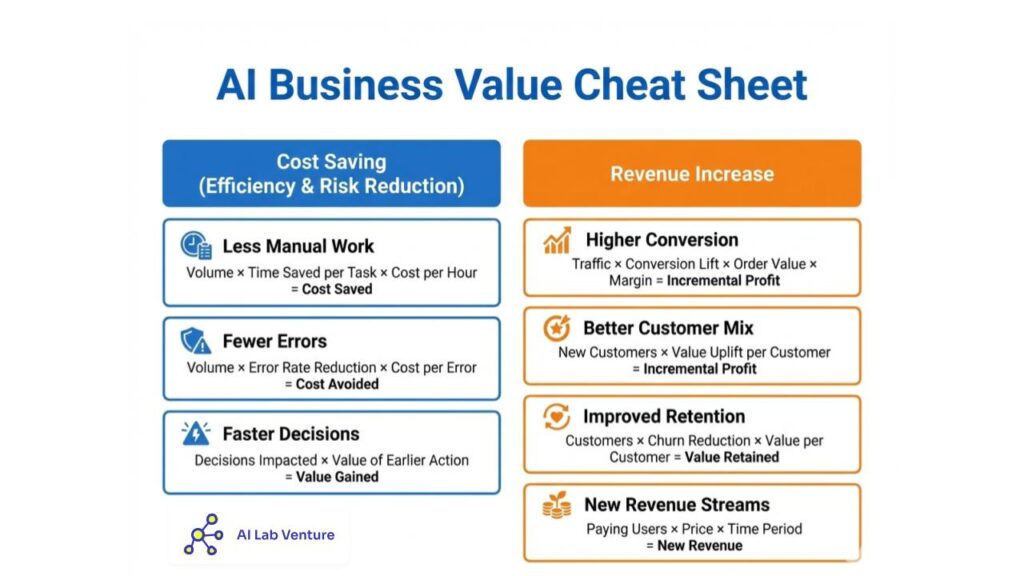
In practice, most AI benefits fall into two buckets:
1. Cost reduction — doing the same work with less effort
2. Revenue growth — making each interaction more valuable

However, to move beyond experimentation, we need to clearly articulate how an AI project will impact one (or both) of these levers — and by how much.

This article focuses on how to frame those benefits in a clear, testable way. Cost and trade-offs matter, but we’ll cover those in a separate post.

Let’s walk through both with concrete examples.


1. Cost Reduction:
1.1 Less manual work

AI reduces repetitive human effort by automating parts of a task, lowering the time spent per case.

Example:
A support team handles 50,000 tickets/year.
AI drafts first responses, saving 3 minutes per ticket.
At $40/hour, that’s:
50,000 × 3 ÷ 60 × $40 ≈ $100,000 per year (cost saved or capacity freed).

1.2 Fewer Errors

AI reduces errors that cause rework, delays, or compliance issues.

Example:
A team processes 100,000 records/year with a 5% error rate.
AI reduces errors to 3%.
Each error costs $15 to fix.
100,000 × 2% × $15 = $30,000 per year avoided.

1.3 Faster Decisions

AI accelerates decision-making by flagging issues earlier, reducing losses or delays.

Example:
An AI fraud model flags 500 high-risk cases/year two days earlier.
Early action prevents $400 loss per case on average.
500 × $400 = $200,000 per year in prevented losses.

2. Revenue Growth:
2.1 Uplift conversion

AI can help you improve conversion from (i) recommending better products, (ii) personalising messages, and (iii) pricing more intelligently.

Example:
An e-commerce site has 200,000 visits/year with a 2.0% conversion rate.
AI-driven recommendations lift conversion to 2.3%.
Average order value = $120, gross margin = 40%.
Incremental profit:
200,000 × 0.3% × $120 × 40% ≈ $28,800 per year.

2.2 Better Customer Mix

AI enables better customer targeting by leveraging data-driven analysis.

Example:
A subscription business acquires 5,000 new users/year.
AI targeting increases average annual profit per user from $180 to $210.
Incremental profit:
5,000 × $30 = $150,000 per year.

2.3 Improve Retention

AI identifies churn risk early and triggers timely interventions.

Example:
A platform has 20,000 customers with 15% annual churn.
AI reduces churn to 14%.
Average annual profit per customer = $500.
Customers saved:
20,000 × 1% = 200
Incremental profit:
200 × $500 = $100,000 per year.

2.4 New revenue streams

AI enables new features or products that customers are willing to pay for.

Example:
An AI analytics feature is offered as a $25/month add-on.
1,000 users adopt it.
Annual revenue:
1,000 × $25 × 12 = $300,000 per year

Then subtract incremental AI and support costs to assess net value.


Closing: From Hypotheses to Proof

All the examples above are hypotheses, not guarantees.
They are meant to clarify where AI value could come from and whether it’s worth testing at all. The next step is to prove them through a small pilot or A/B test with clear success metrics and a proper control group.

How to design those pilots and tests — and avoid common measurement traps — is a topic for a separate post.

For now, the goal is simple: make AI value explicit and testable before you scale.

Leave a Comment

Your email address will not be published. Required fields are marked *